
Longview Resident Lookup Records
Different Longview records answer different questions. The Gregg Appraisal District search can supply an appraisal account, a situs address, and an owner lead. A recorded deed can connect a named party to an instrument, but neither source proves that person currently lives at the property. The court systems record parties and case events. Vital indexes add a date and place when access rules permit. A historical directory or newspaper gives a dated household clue rather than a current one.
| Record | What It Confirms | Where | Access |
|---|---|---|---|
| Appraisal parcel | Owner lead, situs and mailing fields, appraisal account | Gregg Appraisal District | Public search, subject to appraisal disclaimer |
| Recorded instrument | Named party, instrument, date, and property description | Gregg County Clerk | Index or copy route; it does not establish occupancy |
| Court docket | Party role, filing, event, and displayed disposition | Gregg Odyssey or municipal custodian | Court-specific public display and copy rules |
| Vital index | Event name, date, county, and other index details | DSHS Vital Statistics | Underlying record age and eligibility rules apply |
| Historical directory | Dated address or household lead | Robbins Genealogy and Local History Room | Collection, library-card, and onsite terms vary |
Start with the source that fits the detail already known. An exact historic address often makes GCAD or the Clerk a useful first stop. A date and place may point instead to a vital index. When the goal is only to distinguish two people with the same name, independent dates, addresses, case numbers, or party roles matter more than the number of search hits.
Note: A Longview address can cross city, ETJ, postal, or county contexts, so identify the record custodian before drawing conclusions from a result.
Longview Court Lookup Choices
The Gregg Odyssey public portal opens with Civil, Family & Probate Case Records; Criminal Case Records; Court Calendar; Jail Records; and Jail Bond Records. Its location, party, case, and date controls appear after a category is chosen. The live post-selection field set was not captured during research, so confirm the active form before relying on its labels or coverage. The portal is an entry point, not a single statewide answer for every trial case.
Longview Municipal Court is a separate custodian for Class C and fine-only matters. The city says its public display includes open or active matters and closed cases with conviction, but it does not display dismissed or not-prosecuted matters. An omission under that display rule does not mean that no event occurred. District and county-level records belong with the appropriate Gregg court or clerk, not with the municipal court simply because the name is familiar.
For a visual check of the categories before starting a Longview resident lookup, the Gregg Odyssey portal presents the five public inquiry choices.
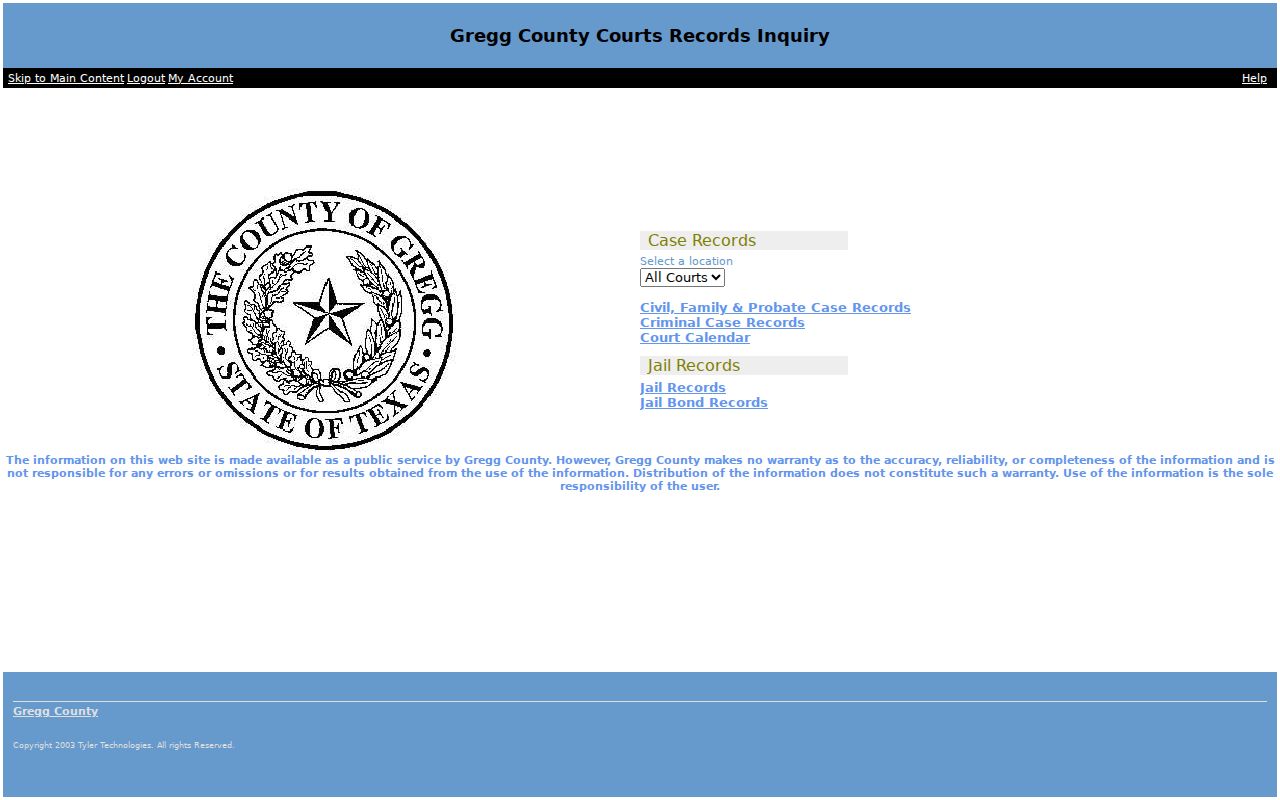
Choose the court layer first, then compare a case number, filing date, county, party role, and docket events before connecting a name to a person.
Longview Docket Result Clues
A docket is the court's running list of case events. A name hit might identify a plaintiff, defendant, attorney, guardian, witness, surety, or an older party. The research could not capture a live Gregg docket because Odyssey stopped at the category and location gate, and the municipal search returned an HTTP 405 response. That gap is a reason to record the portal access date and ask the clerk about an official copy when a result matters.
| Displayed field | Why it matters |
|---|---|
| Court and case number | Separates similarly named cases and identifies the right custodian. |
| Style and party role | Shows how the named person appears in that case. |
| Filing and event dates | Tests whether the record fits the known time period. |
| Case type and event description | Distinguishes the subject of a filing from a broad name match. |
| Disposition, status, and document link | Shows only what the particular portal makes available at that time. |
Index results and images are different things. An index points to a record. An online image is a viewable copy when the custodian provides one. A certified copy is issued by the proper custodian and carries its certification, so it should be requested when the certified form is actually needed. The District Clerk's published 2026 schedule lists a record-search charge, page-copy charge, and certification charge, all worth confirming before ordering.
Verify a Longview Resident
Use a Longview resident lookup as a sequence of independent checks. Begin with a known name plus a non-sensitive anchor, then separate an owner name from a situs address, a mailing address, and a grantor or grantee role. A match becomes more credible when two sources agree on a date, place, or record number. A single name search never resolves all of those distinctions.
- Search GCAD by owner name or a simple street name, then keep the property or geographic ID, the address fields, and the tax year as leads.
- Check the GIS parcel layer for location and parcel context, but treat its owner and deed fields as leads because the published source data can be older.
- Use the County Clerk index to compare recorded-party names, instrument number, date, and legal description. Follow the prior instrument where a deed cites one.
- Choose the correct court portal only if a court question remains, then compare role, court, case number, and event dates rather than relying on the name alone.
- Use a public DSHS index or an eligible custodian request for date and place anchors, then preserve only the minimum details needed for the question.
- Docket
- The court's event record for a case, not a biography of each person whose name appears.
- Index and image
- An index locates a record; an image is the document view when supplied. Either can have omissions or access limits.
- Certified copy
- A copy formally issued by the office that holds the original record, sometimes with a separate fee and eligibility rule.
For an older address clue, the Longview city directory collections can add a dated, independent entry. Keep the publication year beside the entry because a directory can lag the household it describes.
Longview Vital Index Matches
Texas DSHS birth and death indexes organize searchable leads by surname, given name or initials, event date, county, and sex. The digital index route covers births from 1925 forward and deaths from 1965 forward; earlier microfiche begins around 1903. Those dates describe the index route, not universal public access to every underlying certificate.
Texas Government Code §552.115 sets public-access ages for many birth and death records: 75 years after a birth and 25 years after a death, with a separate rule for an unidentified death. The Gregg County Clerk provides local birth and death certificates under its own request process. Its mail form requires a valid-photo-ID copy, sworn or notarized statement, money order, and return envelope. A marriage license copy comes from the County Clerk, while a divorce decree belongs with the District Clerk.
The DSHS indexes page explains the state-level index and request paths used to add a date or place anchor to a Longview resident lookup.
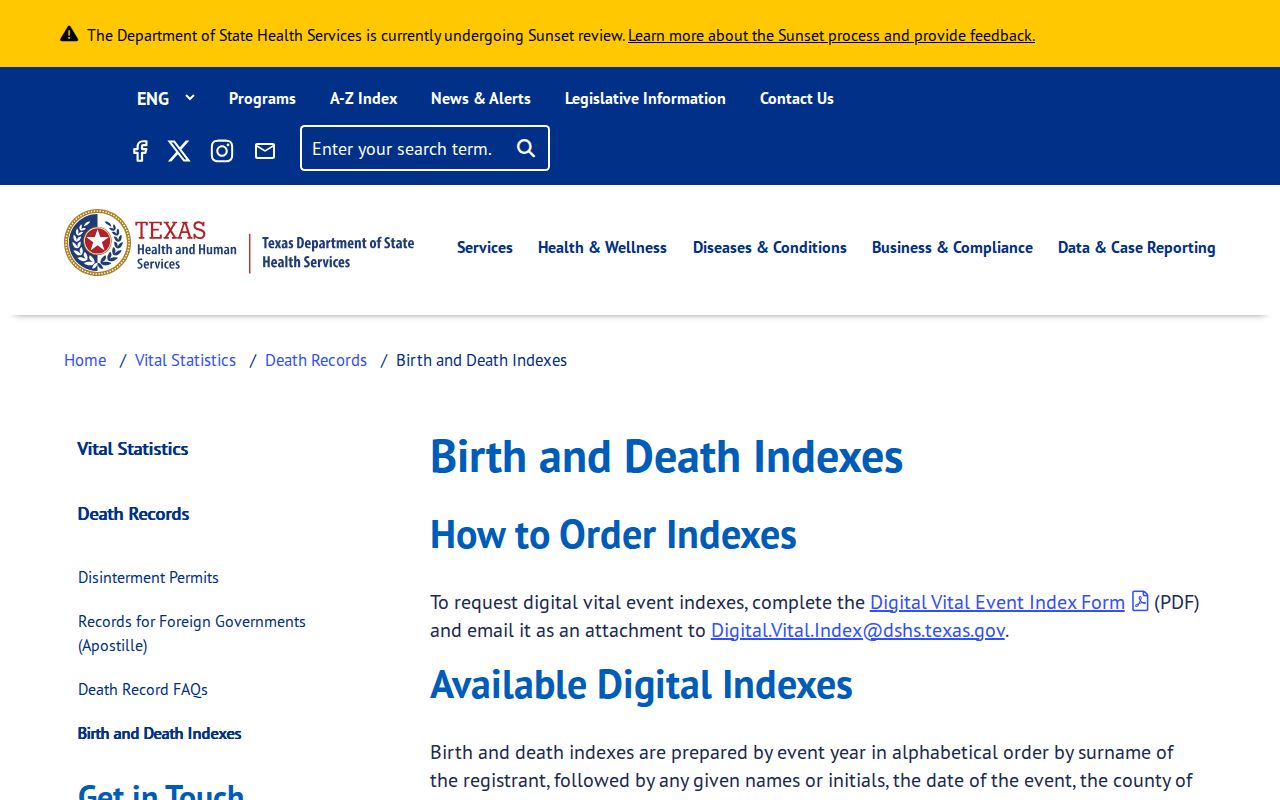
An index entry is a lead, not a certificate and not proof that two people with a similar name are the same person.
Longview Voter Lookup Boundaries
The official Texas My Voter Portal is a status and polling-place route for the individual whose information is used to begin the search. It is not a casual by-name resident roll. Statewide or county voter-data requests are separate procedures that require the requester and affidavit, with filters for categories, geography, dates, elections, and documented demographic or participation fields.
Texas law protects Social Security numbers, Texas driver-license or personal-identification numbers, telephone numbers, and qualifying protected addresses. Keep a voter question civic and follow the applicable affidavit and use rule. If a protected-address signal appears, stop rather than attempting to combine sources to work around it.
The Texas voter portal shows the credentialed entry screen that distinguishes an individual status check from a public-file request.
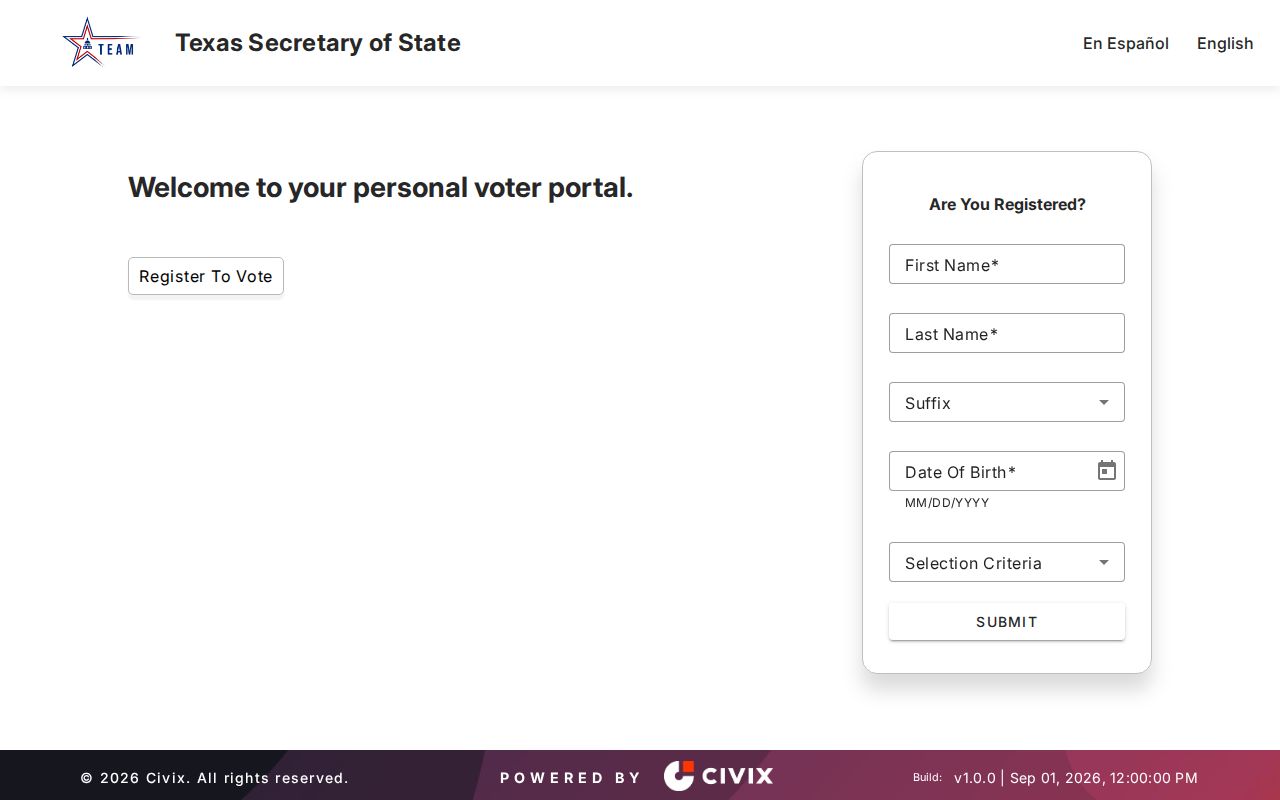
Use City GIS polling and district layers only to understand geography. The SOS portal and Gregg Elections remain the authorities for registration administration.
Note: A public voter record has statutory limits, and it should not be treated as a complete profile of any Longview resident.
Longview Record Request Paths
When an online result is incomplete, request an existing, defined record from the office that created it. Texas Government Code Chapter 552, the Public Information Act, calls for a written request to the governmental body's public-information officer or designated route. It does not require an office to create a new database. Ask for a case number, address, record type, date range, or inspection of a defined file, and request a fee estimate if the scope may be broad.
For city-held material, Longview's JustFOIA request page provides separate City/Fire, Police, and EMS tabs for requests, tracking, and payment. Police and crash material follow their own documented channels, and an incident report is not a general resident index. For older county records or a Clerk portal problem, use the Clerk counter or phone route and the Texas State Library Gregg guide for microfilm leads.
The city records request page illustrates the formal route for defined Longview city files when a public search does not supply the needed record.
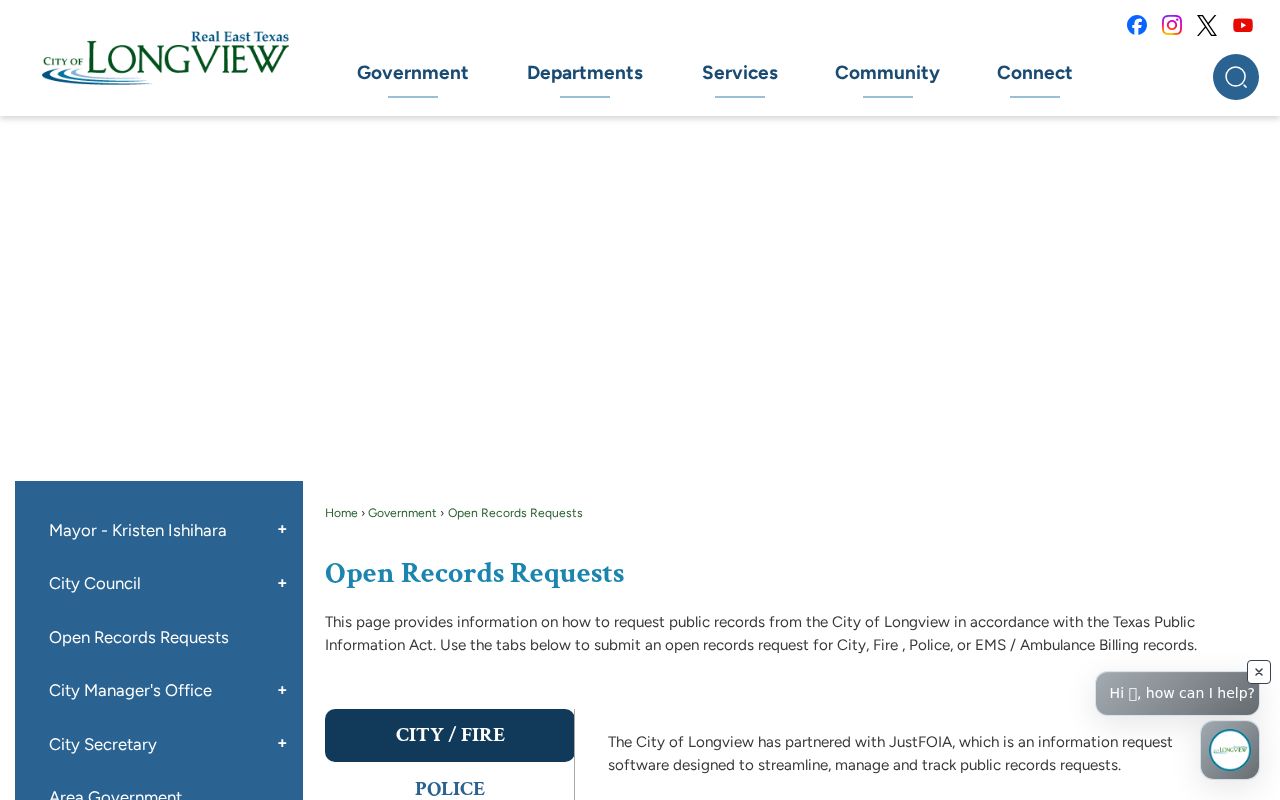
A narrow request preserves the record type and date that make a response useful, while allowing the custodian to apply any required redactions.
Longview Same-Name Checks
Myth: a shared name verifies a person. Longview records can contain initials, spelling changes, old house numbers, publication lag, and similar family names. Use at least two independent anchors: a name plus an exact date and place, a name plus a consistent historical address, or a case or instrument number confirmed by a second source. Keep “found an entry” separate from “verified identity.”
A property role is especially easy to overread. GCAD's legal descriptions and acreage are for appraisal purposes and should be checked before use in a legal document. Its current software-conversion notice also warns that acreage on some Notices of Appraised Value may be inaccurate and certified totals were not yet available during the review. Preserve the parcel ID and ask GCAD for specification information if the figure is important.
Note: Court, appraisal, directory, and vital sources each have their own date and purpose, so agreement between two dated sources is more useful than repetition in one system.
Longview Resident Lookup Limits
Texas public access is not universal permission to assemble or republish every field. The Texas Address Confidentiality Program provides a substitute mailing address for qualifying participants, and voter confidentiality can protect residence addresses and identifiers. Do not try to defeat either safeguard. Redact full birth dates, signatures, identification numbers, protected addresses, minor information, medical details, victim information, account data, and portal credentials from notes or examples.
Lawful use. Use Longview resident records for a personal, lawful purpose such as family history, reconnecting, estate research, or verifying a record with its custodian. Never use a lookup to stalk, harass, intimidate, or endanger anyone.
When a record seems wrong, preserve the source URL and date, then contact the originating custodian. The best correction path is the office that made or holds the record, not a copied search result.