
Longview City Directory Holdings
Longview does not have one continuous directory run. The Texas State Library lists volumes for 1932, 1937, 1951–52, 1953–54, 1961–1981, 1982–1990, 1992, 1993, and 1993–94. The Mary Lee Robbins Genealogy and Local History Room is the practical local starting point because it combines directory material with cemetery records, census material, microfilmed newspapers, and librarian assistance. Treat the listed years as known holdings, not proof that every intervening year was printed or survives.
| Collection | Years | Where Held | Access |
|---|---|---|---|
| Longview city directories | 1932; 1937; 1951–52; 1953–54; 1961–1981; 1982–1990; 1992; 1993; 1993–94 | Texas State Library list and local reference holdings | Reference or in-person request; inspect alphabetical and address sections |
| Longview criss-cross directories | 1967–1996, with 1983 absent from the LOC guide | Library of Congress guide and collection | Request city, state, directory type, and year |
| Longview telephone directory object | 1954 resource linked by the Centennial page | City of Longview digital archive | Online viewer, but loading can prevent entry review |
| Gregg County Historical Museum archive materials | Not stated for directory coverage | Gregg County Historical Museum archive | Appointment research; reproduction terms apply |
The Library of Congress guide separately identifies Longview criss-cross volumes from 1967 through 1996, with a missing 1983 listing. A criss-cross volume begins with an address rather than a surname, so it is useful when the starting point is a place. The record does not establish a full population count. Publication timing, a temporary move, spelling choices, and missing volumes can all explain why a name is absent.
Longview Directory Help at Robbins
The Mary Lee Robbins Genealogy and Local History Room is at 222 W. Cotton Street and can help match a directory question to a microfilm reel, newspaper source, census material, or local collection. Its main-library hours are Monday through Wednesday 9–7, Thursday through Saturday 9–5, and Sunday 1–5. The librarian and Gregg County Genealogical Society volunteers also provided microfilm and newspaper help at the 2025 Genealogy Help Day, a useful reminder that a human reference route remains available when a name variant defeats a catalog search.
The library page identifies different access conditions for its databases. Ancestry Library Edition is limited to library computers or Wi-Fi, while NewsBank’s Longview News-Journal collection is listed from 1998 to today. Those are companion sources, not replacements for the older historical shelf.
See the Longview local-history collection before visiting for current contact details and access terms.

The library image is an access reminder: record the directory year, page, section, and street spelling before leaving the collection.
Note: A library result may be a lead rather than a final identification, so retain the volume details for later comparison.
Longview Directory Archive Routes
The City’s virtual local-history route links a Longview telephone-directory object in its digital archive. The object’s viewer may stay on “Loading,” and research did not capture a live, redacted entry. That limitation matters. Do not infer a publisher, a complete run, or the fields in a displayed entry until the viewer renders. Save the object URL and page reference when it does, since a general search result can lose the archive context.
The Longview archive directory object is the linked source for this digitized route.
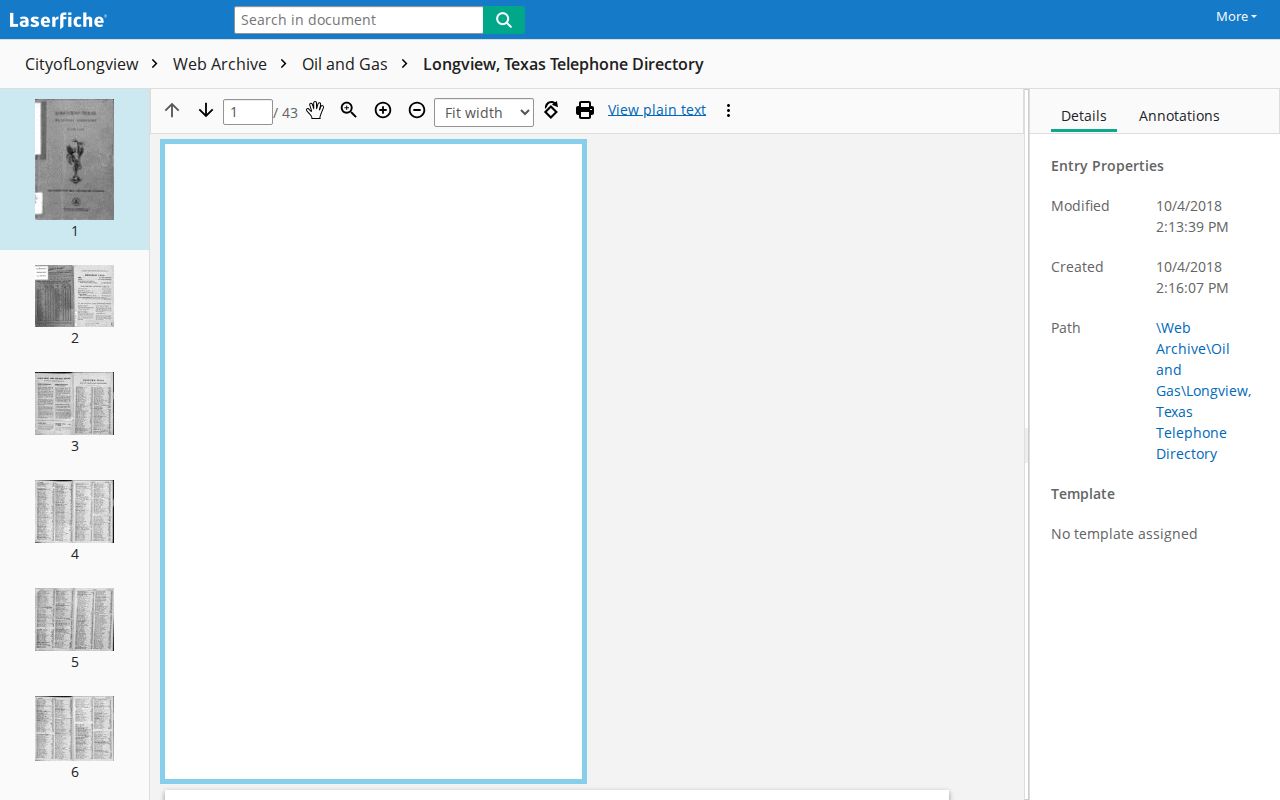
The captured view documents the archive route, not a verified directory-entry sample, so use a rendered page or a physical volume before transcribing a name.
The Gregg County Historical Museum archive adds documents, photographs, and newspaper clippings through an appointment-based research channel. Its archive contact and reproduction rules should be checked before requesting material. Its page does not state a directory-year run, which is why it belongs beside, not inside, the known listed holdings.
Note: Appointment archives can resolve a local context question, but an undated clipping should not be treated as a dated directory listing.
The museum archive page is the source for this access view.
Keep archive notes separate from directory citations, including the collection name, appointment date, and any reproduction restriction.
Reading Longview City Directory Entries
Start by recording what the volume actually shows, rather than assuming that every directory used the same abbreviations or household marks. Research for Longview did not reproduce a live, redacted entry from the digitized object, so the form of a particular entry remains a fact gap. An alphabetical listing may place a surname beside a street address and other notation; an address section can return a named listing at a location. The volume’s title page, introductory matter, and abbreviation key are part of the evidence.
| Publication details | Year, title, publisher if printed, page, and section |
|---|---|
| Alphabetical entry | Exact surname spelling, initials, given name, and any household or occupation notation displayed |
| Address entry | Street number, street spelling, unit or business notation, and the related address-section page |
| Abbreviation evidence | Photograph or transcribe the volume’s own key before expanding a mark |
| Corroboration | Second dated source, such as a deed, census item, newspaper, cemetery record, or permit file |
- Criss-cross directory
- An address-arranged directory that gives an address-to-name lead, unlike the usual surname order.
- Householder index
- An index arranged around a household or address. Its exact form must be confirmed in the individual volume.
- Abbreviation key
- The printed explanation of the volume’s shorthand. Read it before assigning a meaning to an entry.
A dated listing is positive evidence, but it can reflect publication lag, a business entry, a temporary residence, or a transcription issue. Preserve the original spelling before normalizing a name elsewhere.
Longview Criss-Cross Directory Years
The Library of Congress guide gives Longview criss-cross coverage for 1967–1996 and notes a missing 1983 volume. Request the exact city, state, directory type, and year when using that collection. That specificity helps distinguish an address directory from a telephone directory or a conventional alphabetical volume.
Use the address listing as a research lead, then compare it against a dated directory entry, parcel or deed history, and a census or newspaper source where available. The modern parcel and deed route belongs to the Longview by-street records process; the historical shelf should remain a separate layer.
Note: The missing 1983 listing is a collection gap, not evidence that an address had no household that year.
Longview Directory Custody Timeline
The directory shelf sits beside a deeper Gregg County custody trail. The Texas State Library guide identifies deed books and direct/reverse deed indexes beginning in 1873, while the digitized 1940 county inventory describes historical series and custodians. Neither is a resident list, but both can explain where to look after a directory points to a parcel, estate, or older record series.
| 1873 | Gregg County deed books and direct/reverse indexes begin in the State Library guide. |
|---|---|
| 1932 | First Longview city-directory year listed by the Texas State Library. |
| 1940 | UNT’s Gregg County archives inventory documents historical record series and arrangement. |
| 1967–1996 | Library of Congress guide lists Longview criss-cross directories, with 1983 missing. |
| 1993–94 | Latest Longview city-directory year listed in the Texas State Library run. |
The 1940 Gregg County archive inventory is the source for this historical-custody route.
The inventory can help identify a series name or former custodian when a current interface does not reach the needed period.
Longview Directory Gaps Matter
Myth. A missing online page or absent volume does not prove that a person was absent from Longview. The telephone-directory viewer has a documented loading gap, historical newspaper runs are incomplete, and city-directory holdings skip many years. The fallback is concrete: ask the Robbins Room for the relevant directory or microfilm route, consult the Texas State Library city-directory and Gregg County reel guides, then use the County Clerk or another custodian for the official record that fits the question.
For a nineteenth-century address or land trail, the State Library guide and the UNT inventory are better starting tools than a modern interface. Record where a search failed, the date checked, and the alternate collection consulted. That makes later review possible without turning a portal limitation into a historical conclusion.
Tracing Longview Directory Households
For family-history work, build a dated line rather than a loose list of similar names. The strongest sequence pairs several Longview directory volumes with census material, newspapers, cemetery records, and a deed or probate source when a move or death needs explanation. A positive address hit is more useful when its street spelling and directory year are preserved. A missing listing is weaker evidence because Longview’s known runs contain wide gaps.
- Choose the nearest known directory year and transcribe the entry, page, address, and any printed notation.
- Check the next available Longview volume forward and backward, recording moves, spelling changes, or a switch between alphabetical and address sections.
- When the period falls in the criss-cross run, inspect the street listing and retain its page as a separate citation.
- Pair the dated directory points with the appropriate federal census material or library-held census resources, without assuming either source is complete.
- Use a newspaper, cemetery record, probate index, or recorded deed to test a major change in the household trail.
A disappearance can mean a move, a death, a changed spelling, a different listing style, or an unlisted volume. Test those alternatives in dated sources before drawing a conclusion. That approach keeps the record trail from being built on a single attractive hit.