
Finding Longview Resident Records
Longview has no official master list of everyone in town. A useful search starts by matching the question to the record that created the information. An address normally leads to the Gregg Appraisal District, a parcel map, and then a County Clerk instrument. A name with a date may fit a court index, a vital index, a library directory, or a voter-status route. Each source has a different purpose, time frame, and access rule.
Property ownership is not the same as present residence. A directory listing is not identity proof. Court and voter systems have their own display limits. For a sound Longview residents directory result, keep the source date, the jurisdiction, and the record type together. A county record can cover an address outside city limits, while a Longview mailing label can reach beyond the incorporated city.
- Start with an address in the property search, or start with a full name plus a date in the most relevant official index.
- Check the city geography layer to separate city, ETJ, ZIP, and county context before treating a location as a Longview record.
- Confirm a conveyance or legal-description lead through the County Clerk rather than relying on appraisal data alone.
- For an older household, request the right library directory year and compare it with another dated source.
- Use a written public-information request, a counter visit, mail form, or librarian when the needed record is not available online.
Longview Resident Records Offices
Three offices provide the basic Longview resident-records orientation. The County Clerk keeps official instruments and several county record categories. GCAD supplies appraisal leads tied to a property or owner. The state voter route and Gregg County elections administration handle registration information under separate privacy rules. Their records overlap, but none replaces the others.
Gregg County Clerk
101 E. Methvin, Suite 200
Longview, TX 75601
903-236-8430
Texas voter status route
State portal with local registrar support
Gregg County administration is local
903-236-8458
For an address-by-address chain, use the Longview street directory route after the initial office is identified. The Clerk counter is open Monday through Friday, 8:00 to noon and 1:00 to 5:00 p.m., a useful fallback when the online records search does not expose a needed image.
Longview Property Record Path
GCAD is the practical first stop for a Longview property lead. Its search has owner name, street number, street name, property ID, geographic ID, subdivision, neighborhood, tax year, property type, and other filters. A simple partial street or surname search can be narrowed in Advanced Search. The portal describes appraisal data, not a final title opinion, so confirm legal descriptions and recorded transfers with the Clerk.
| GCAD field | Use in a Longview search |
|---|---|
| Owner Name | Find an appraisal account by a recorded owner name. |
| Street Number and Street Name | Locate a situs-address lead when the address is known. |
| Property or Geographic ID | Keep a parcel-specific reference while comparing map and Clerk material. |
| Subdivision or Neighborhood | Narrow a broad Longview street search by development area. |
| Tax Year and Property Type | Limit the context of an appraisal result. |
The current GCAD notice warns that a software conversion can affect acreage shown on some notices and that certified totals were not available during review. Treat that warning as part of the result. A parcel ID helps an office answer a question, but it does not turn a screen result into a recorded deed.
The County Clerk office page is the authoritative route to its records-search link and counter alternatives.
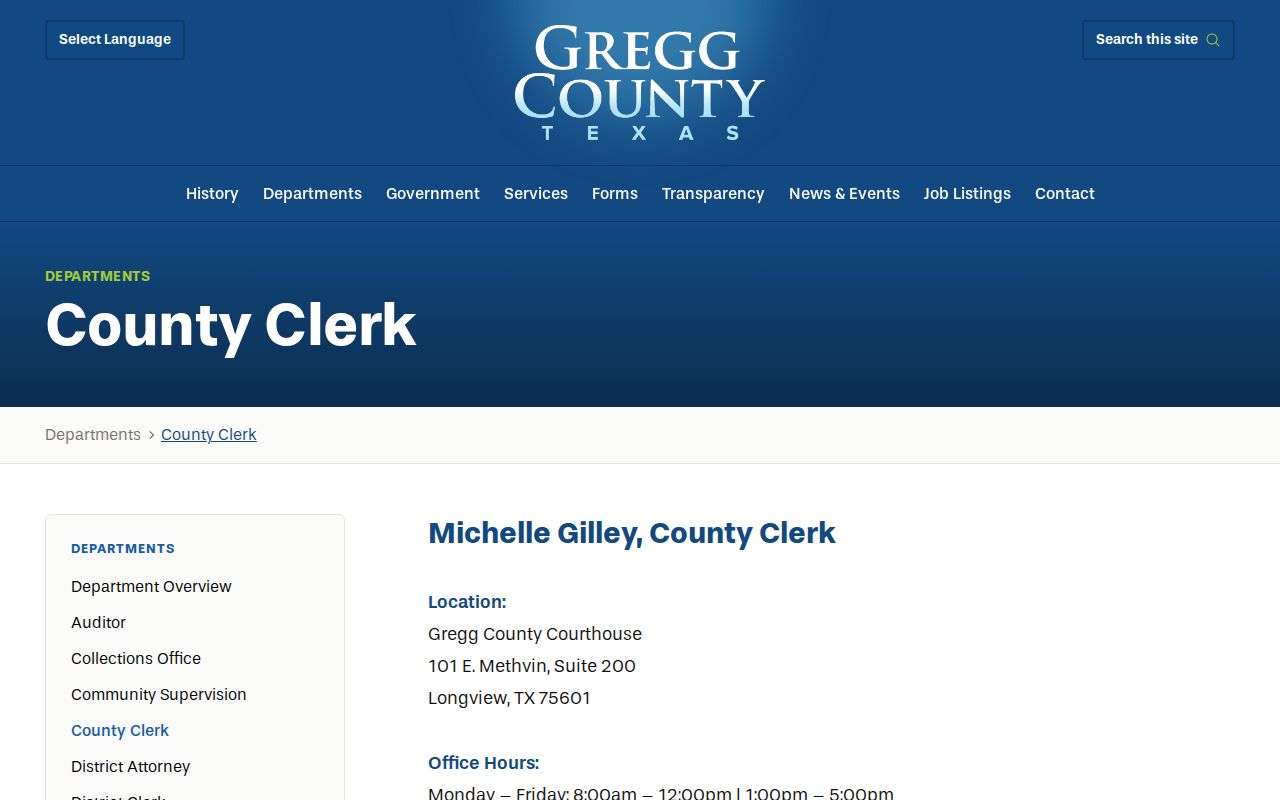
The Clerk access page connects a property lead to official instruments, copies, and the counter route when an online result is incomplete.
Longview Boundaries Shape Searches
Longview city limits, the ETJ, a postal ZIP, an appraisal jurisdiction, and a polling district are different boundaries. The City ArcGIS services provide streets, addresses, parcels, city limits, school and voting districts, ZIP geography, and other local layers. Those layers help decide which custodian matters, especially near an annexation edge or a neighboring postal place.
The parcel layer has rich owner, address, deed, and legal-description fields, but its published source dates include 2012 and 2013 data. That makes it a useful map lead, not proof of present ownership or a current legal boundary. Verify a current question with GCAD and the County Clerk. The City 9-1-1 Addressing office also explains that a number correction does not automatically update postal, utility, appraisal, bank, or navigation records.
- Parcel
- A mapped unit of land used in appraisal and mapping systems.
- Index
- A finding tool that points to a record, not always the record image itself.
- Criss-cross directory
- An address-arranged directory that can provide a dated name or business lead.
- Record roll
- A list or index created for a specific official purpose, with its own scope and limits.
Current Longview Resident Directories
Current Longview directory-style sources are partial by design. The appraisal roll can show an owner and property data. The Clerk index can identify parties to recorded instruments. A voter-status route serves the individual voter, while the statewide public-data request is a separate affidavit-based procedure. City files such as permits, cemetery material, or code records are place-based records, not household lists.
| Longview source | What it can establish | Custodian | Access channel |
|---|---|---|---|
| GCAD property account | Appraisal and owner lead tied to a parcel | Gregg Appraisal District | Search portal, phone, or office |
| Official-record index | Recorded parties, instrument, and deed trail | Gregg County Clerk | Portal link, counter, phone, copies |
| Voter status or data request | Individual status route or constrained public data | SOS and Gregg elections | Portal or affidavit request |
| City address files | Permit, inspection, code, cemetery, or GIS context | City of Longview | City department or written request |
| Association certificate listing | Management-certificate context, not a member list | Texas state database | Search with its stated reliability limits |
A person-focused question benefits from the narrower checks on the Longview resident lookup page. A map, a tax account, or an association listing should never be stretched into a claim about every person at an address.
Longview Voter Record Limits
Texas My Voter Portal begins with a Texas driver license or personal-identification number and is intended for the individual voter’s status and polling-place route. It is not a public name-and-address directory. A public voter-data request instead uses SOS forms, an affidavit, scope choices, and statutory restrictions. Gregg County elections administration is the local registrar, while the city map can assist with voting geography.
Texas law protects Social Security numbers, driver-license or personal-identification numbers, telephone numbers, and qualifying protected addresses. An address confidentiality signal is a reason to stop, not a missing-data puzzle. The request process also distinguishes active, suspense, and cancelled categories, so a status label needs its date and agency context.
Texas My Voter Portal shows the current credentialed starting point.
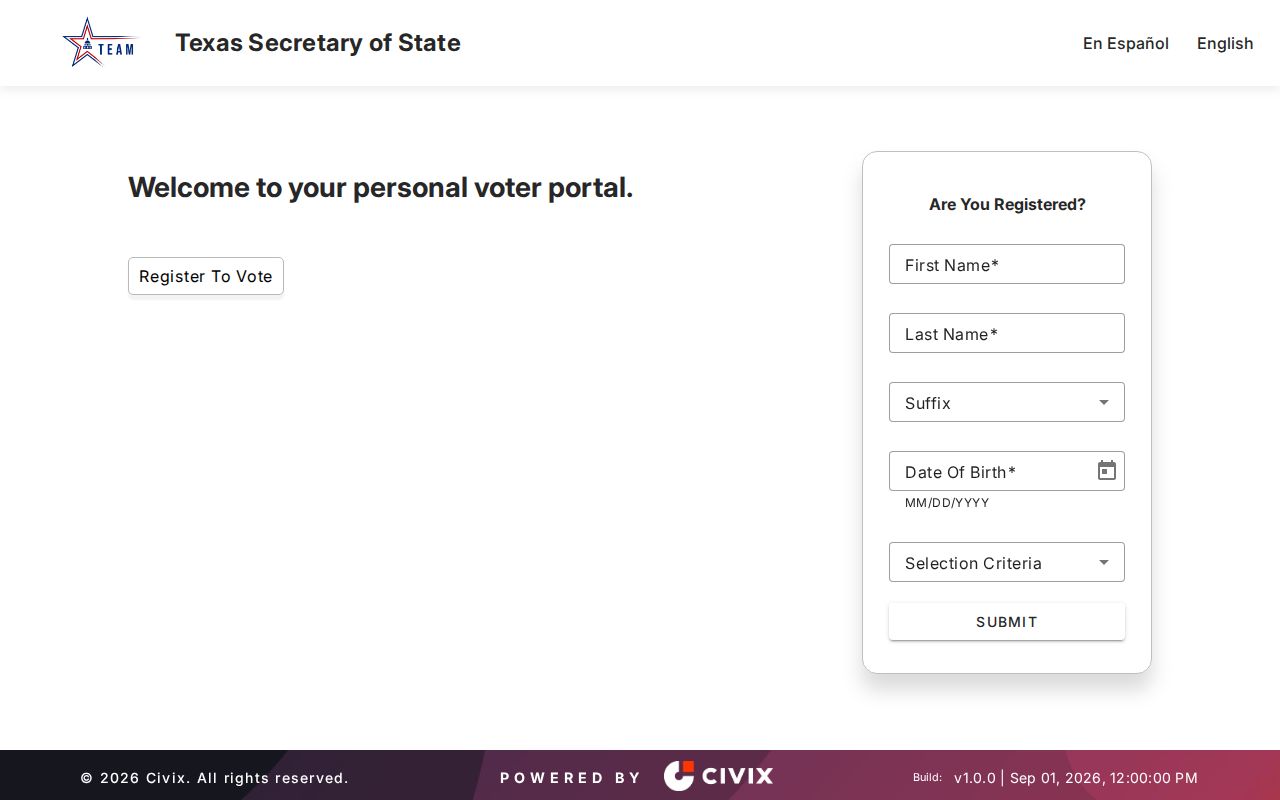
The entry screen makes clear that voter status is controlled access for the voter, not a substitute for a public resident roll.
Longview Court Search Layers
County and municipal court searches answer different questions. Gregg Odyssey begins with Civil, Family and Probate, Criminal, Court Calendar, Jail Records, and Jail Bond Records choices. The exact fields appear after category and location selection. Longview Municipal Court is a separate city system for Class C and fine-only matters. Its public display includes open or active matters and closed cases with conviction, but not dismissed or not-prosecuted cases.
A name hit can identify a party, attorney, witness, guardian, or another role. Compare the court, case number, filing date, party role, and events before linking a record to a Longview person. The state does not offer one complete public trial-court index, so a no-result can mean the wrong custodian, a spelling variant, an access limit, or a display cutoff.
Gregg Odyssey is the county’s observed public portal entry.
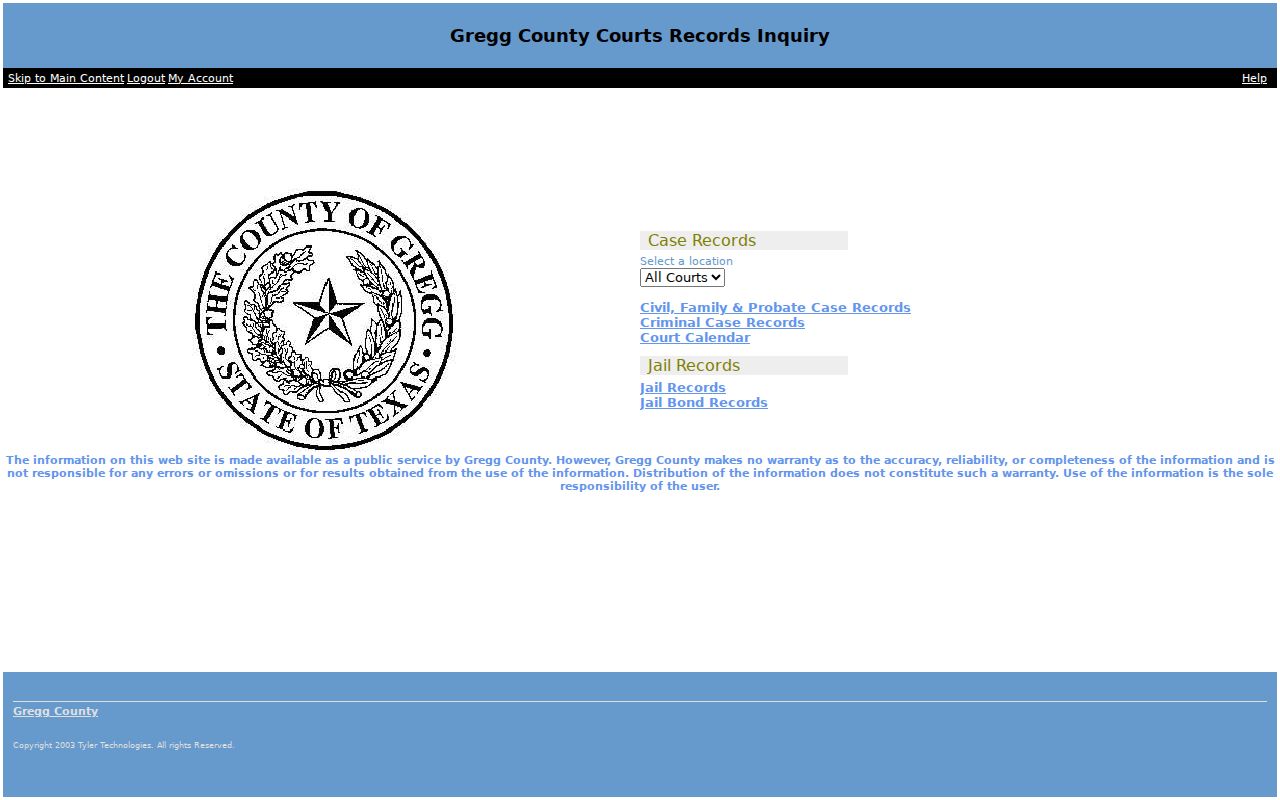
The portal’s category choices show why a court search should begin with the right court layer rather than a broad name assumption.
Longview Records Request Route
When a needed City record is not online, the Texas Public Information Act provides a written-request route to the governmental body’s public-information officer or designated system. Ask for existing records, fields, reports, or inspection of a defined file. State a date range, address or case number, record type, and preferred format. The law does not require an agency to create a new directory from scattered data.
Longview’s JustFOIA service separates City and Fire, Police, and EMS or Ambulance channels. It offers request tracking, payment, and electronic delivery, and advertises anonymous submission. Police subpoenas and certain law-enforcement requests follow another route; EMS records after February 1, 2025 use a separate provider process. Requesters should ask for a fee estimate when scope is broad and preserve the agency response date.
Longview’s public-records request page provides the official request entry point.
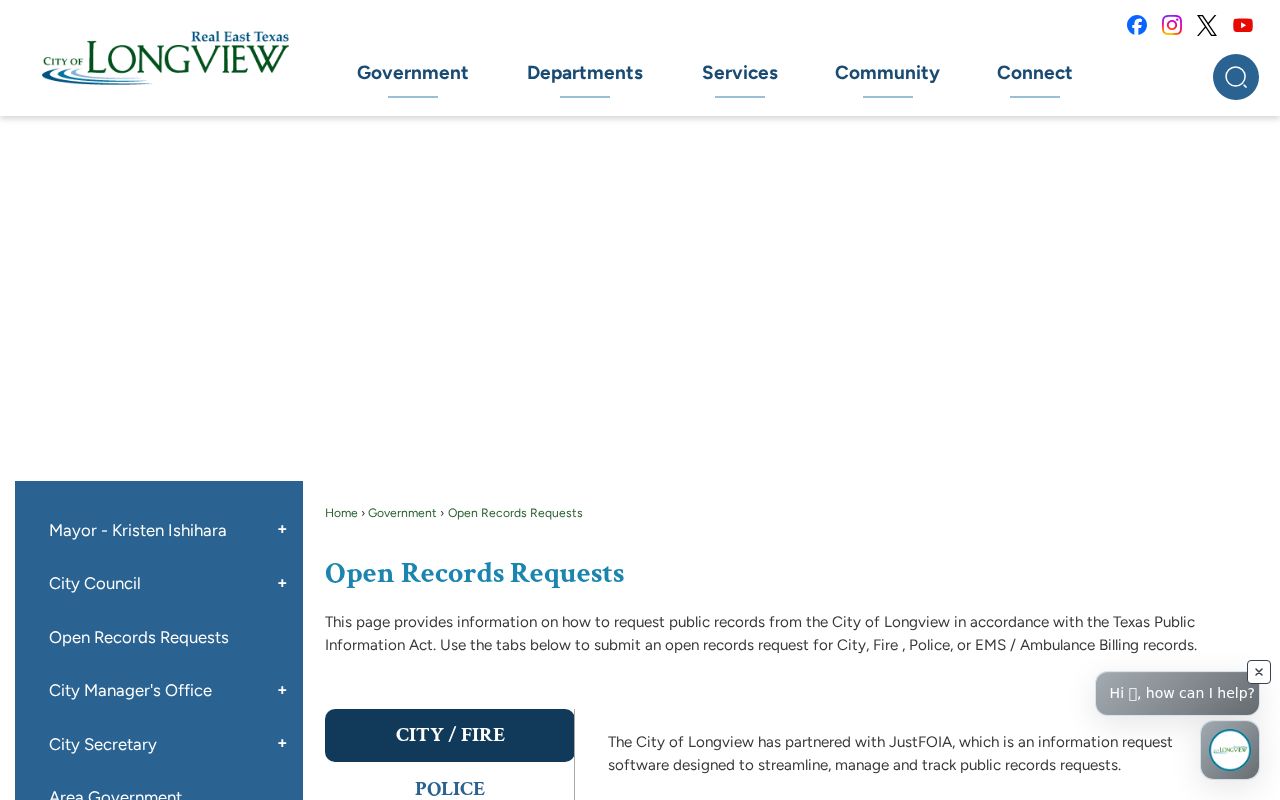
The City and Fire, Police, and EMS tabs reinforce that the correct custodian depends on which Longview record was created.
Historical Longview Resident Directories
Historical Longview directories add a dated household or address lead. Texas State Library holdings list 1932, 1937, 1951–52, 1953–54, 1961–1981, 1982–1990, 1992, 1993, and 1993–94. The Library of Congress guide lists Longview criss-cross directories from 1967 through 1996, with a 1983 gap. A missing listed year does not prove a person was absent.
The full historical-shelf method belongs with the Longview city directories. For a quick check, record publication year, page, entry type, street spelling, and whether the volume is alphabetical or address-arranged. Pair a positive entry with another dated source before drawing a family-history or house-history conclusion.
Longview Library Directory Years
The Mary Lee Robbins Genealogy and Local History Room at Longview Public Library is the strongest local help desk for directories, cemetery records, census microfilm, newspapers, vital references, and genealogical files. Its main branch is at 222 W. Cotton, and librarians can help match a question to a directory year, a reel, or a newspaper run. Some library databases require a card and PIN, and Ancestry Library Edition is limited to library computers or Wi-Fi.
NewsBank lists the Longview News-Journal collection from 1998 to today, while earlier local newspaper runs are uneven. The digitized telephone-directory object includes a 1954 resource, but its viewer can remain at Loading. Use the physical collection, reference help, or archive object details when an interface fails instead of treating the failed viewer as proof that no volume exists.
The library’s genealogy and local-history page lists the collection and current visit information.
Longview Vital Record Custodians
Birth, death, marriage, and divorce records do not share one office. Gregg County Clerk handles local certified birth and death copies and marriage-license copies. Texas DSHS handles statewide certificates, index and verification routes, while the District Clerk is the custodian for a divorce decree. The correct route turns on event type, place, age, and the requester’s eligibility.
Texas access ages are 75 years for birth records, 25 years for death records, and one year for unidentified-death records under Government Code Chapter 552.115. The state digital index covers births from 1925 and deaths from 1965, with earlier microfiche around 1903. An index is only a lead. It does not replace a certificate, and current records can require an eligible relationship or another statutory basis.
Texas vital index information explains its coverage and request rules.
Longview Deed Preservation Trail
Longview’s older record trail is unusually tangible. The State Library’s Gregg guide identifies direct and reverse deed indexes and deed books beginning in 1873, including Deed Volumes A through R through 1901. The 1940 Gregg County inventory at UNT describes historical series and custodians. Both are fallback tools when a modern portal lacks an image or does not state its coverage.
Preservation is also current. Reporting in 2025 described restoration of an 1870s deed volume and roughly a dozen books, with digital copies intended as books returned to public access. A 2026 report described ongoing film and digital custody work. The lesson is practical: note whether a Longview record is an index, a paper volume, microfilm, a scanned image, or a certified copy before relying on it.
That distinction changes the next step. An online index may provide only a book and page. A reel guide may identify the older volume that the portal never names. A counter request can be more useful than a second browser search when a scan is in conservation or an image system is unavailable. Record the office, the series name, the volume or reel, and the date checked. Those details make it possible to return to the same Longview source without confusing a catalog entry with the record itself.
The Texas State Library Gregg County guide gives reel-level alternatives for deeds, probate, vital records, and court material.
Longview Protected Address Signals
Public access has firm limits. Texas Address Confidentiality Program participants can use a substitute mailing address, and voter confidentiality rules protect qualifying addresses and sensitive identifiers. The federal motor-vehicle privacy law also restricts personal information from motor-vehicle records. A protected result should not be pieced together from other sources.
Privacy limits also explain why two official sources may not match. An address can be withheld, a result can be redacted, or a court display can omit a category of case. A careful Longview search records that limit and turns to the custodian for an explanation when appropriate. It does not infer a hidden address or publish identifiers that a record system has protected.
| Official route | Best use | Limit to remember |
|---|---|---|
| Custodian record or index | Confirm a specific documented event or instrument | Scope, redactions, and date control what is visible |
| Library or archive collection | Trace a historical address or household lead | Runs are incomplete and entries need corroboration |
| Commercial lookup category | Understand that nonofficial products exist | Do not treat a result as an official or complete record |
Note: Keep the official source URL and access date with any Longview result, then ask the custodian to confirm a record that matters.